Hizen no Kuni ju Higo Daijo Minamoto Tanehiro Katana
The swordsmith Minamoto Tanehiro, whose given name was Ichitar?, was an outstanding master of traditional Japanese craftsmanship, with his primary period of activity spanning the early Edo period from the late Kan'ei era (around 1640) to the Kanbun era (c. 1661–1673). He originally hailed from the highly specialized Ichita lineage, a craft family closely related to the prominent smiths Morihide and Ieyasu of Hirado. In the course of his career, Tanehiro relocated to Saga, the economic and political center of power in Hizen Province, which was under the strict control of the powerful Nabeshima clan. This clan maintained a rigid monopoly over the region's premium iron sands and organized the local forging schools into a highly efficient economic empire, whose blades were coveted throughout Japan as luxurious status symbols and renowned for their uncompromising cutting ability.
In contrast to the extremely prolific main Tadayoshi line, Tanehiro worked in a much smaller, highly specialized workshop, crafting blades in limited quantities for select local clients; as a result, signed works by him are considered extreme rarities on the global collector's market today. Due to his exceptional talent, he was initially granted the imperial honorary title of Higo Daijo (Court Official of Higo Province) before later receiving a prestigious promotion to the even higher rank of Higo no Kami (Governor of Higo), underscoring his elite status within the swordsmith hierarchy of the Edo period.
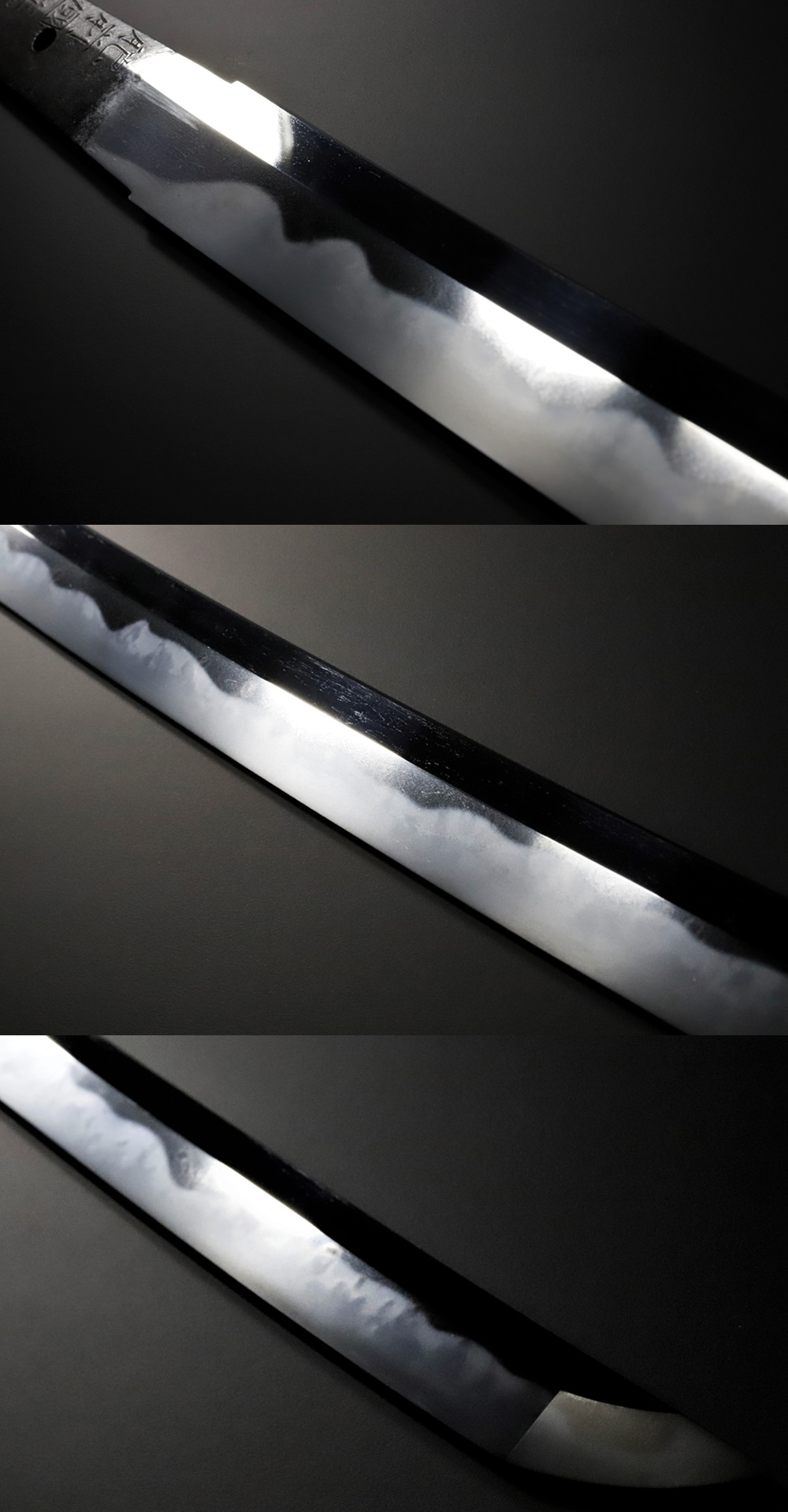
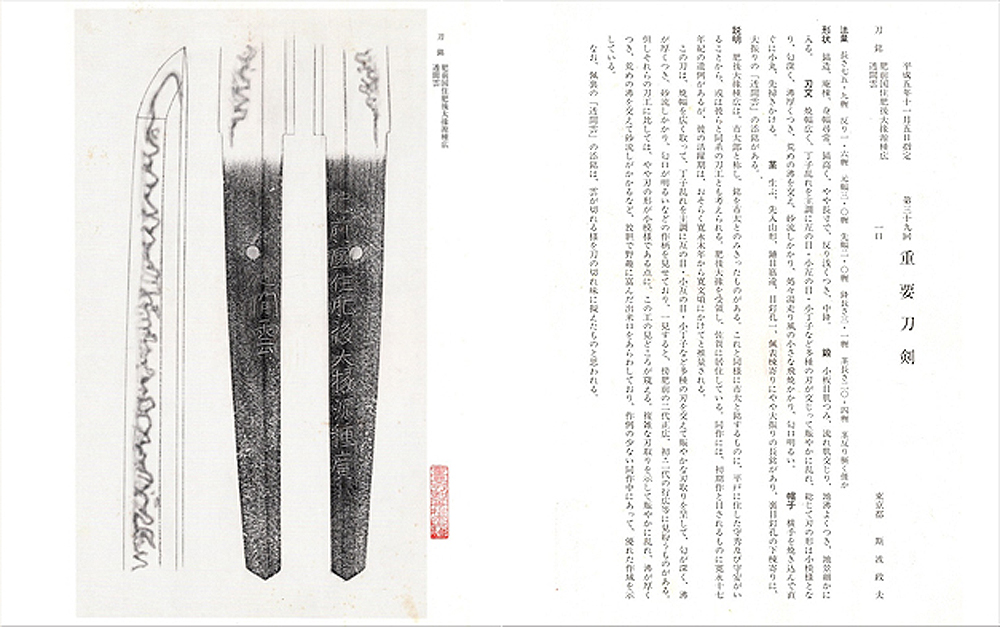
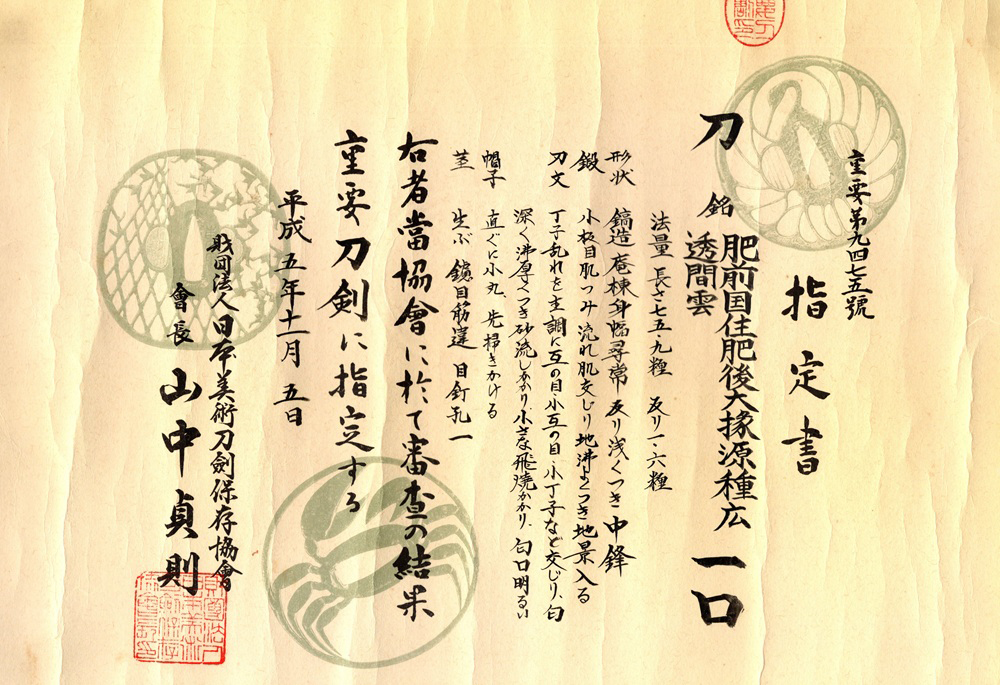
The present long sword was officially classified as Juyo Token by the Society for the Preservation of Japanese Art Swords (NBTHK) under certificate number 9475 on November 5, 1993 (Heisei 5) during the 39th Juyo designation round, making it the only documented katana by this smith to have ever achieved this museum-grade status. The blade features an exceptional length for its era of 76 cm, an elegant, moderate curvature of 1.5 cm, and a powerful base width of 3.2 cm, tapering to a point length of 3.1 cm. Forged in the classic shinogi-zukuri style with a ridged blade back and a high shinogi, the surface exhibits an extremely dense, fine-grained ko-itame-hada, interspersed in places with flowing nagare-hada lines.
The blade surface is rich in sparkling martensite crystals and exhibits the finest dark chikei structures, while the magnificent tempering pattern is dominated by a wild clove-blossom style (choji-midare), interspersed with wavy structures and activities such as sunagashi and tobiyaki. A bright, clear transition line (nioi-guchi) visually mirrors the proper name 'Sukimagumo' (Sunlight through Clouds) chiseled onto the back of the unaltered original tang (ubu-nakago), which symbolically compares the silent breaking of sunlight through a dense cloud cover with the legendary sharpness of this weapon. To protect these invaluable blade structures, the katana today rests in a custom-made shirasaya featuring a masterful expert sayagaki by Honma Junji.
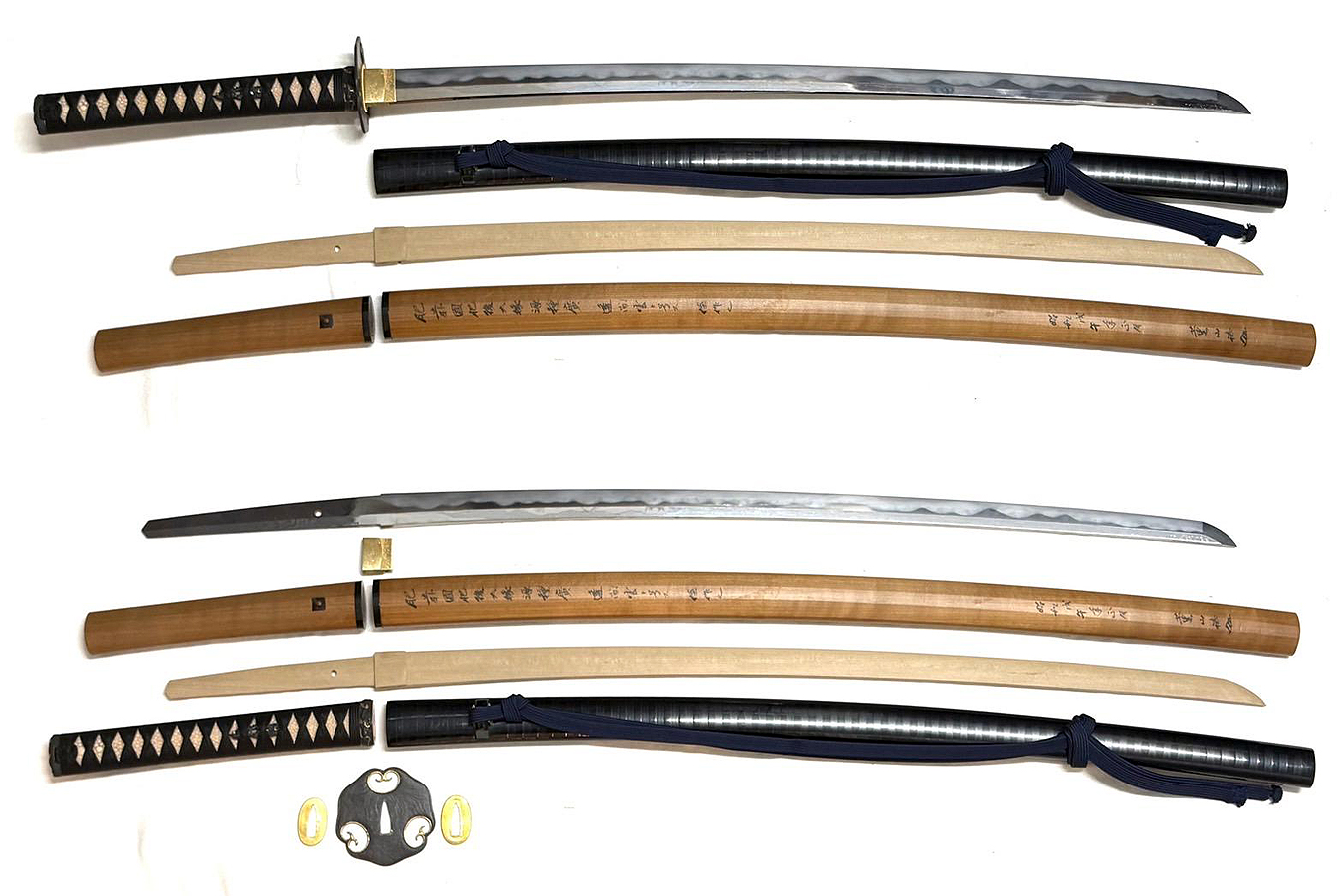
The original koshirae is stored separately from the blade and stabilized by a precisely fitted wooden model of the blade, known as a tsunagi, which protects the delicate inner wooden walls from mechanical wear and ensures the preservation of the ensemble in top condition. The scabbard is crafted as an inro-kizami saya, where the magnolia wood is segmented into fine, horizontal ribs and coated with countless layers of deep black urushi lacquer, offering the samurai a non-slip grip during daily use.
The guard is a signed work by the Edo-period master Kunitsugu, executed in the characteristic four-lobed shape (mokko-gata) made of highly compacted, forged iron, whose openwork apertures display the heart-shaped wild boar’s eye (inome) as a protective symbol against fire, alongside scrolled karakusa tendrils representing longevity. These cutouts are bordered with paper-thin gold inlays (kin-zogan), while soft copper inserts (sekigane) at the center ensure a millimeter-precise adjustment. The hilt continues the noble theme with a tight, black wrapping over radiant white rayskin (samegawa), concealing beneath the silk—as well as on the fuchi-kashira fittings—sculpted dragons made of deep black shakudo with gold accents. These dragons form a flawless mythological unity with the blade, as they, as rulers of the clouds, symbolically unleash the light of the 'Sukimagumo' the moment the sword is drawn.
Hizen no Kuni ju Higo Daijo Minamoto Tanehiro Katana - #S0108
Sigature: Hizen no Kuni ju Higo Daijo Minamoto Tanehiro
Sukimagumo
Nagasa: 76.00 cm
Sori: 1.5 cm
Motohaba: 3.20 cm
Motokasane: 0.75 cm
Hamon: Choji-midare with Gunome, Sunagashi and Tobiyaki
Jihada: Ko-itame with Nie and Chikei
Paper: NBTHK Juyo Token
Koshira: Shirasaya +Katana Koshira
Price: EUR