Kyo-Shodai Tanba-no-kami Yoshimichi
Juyo Token Katana – Kyo-Shodai Tanba-no-kami Yoshimichi
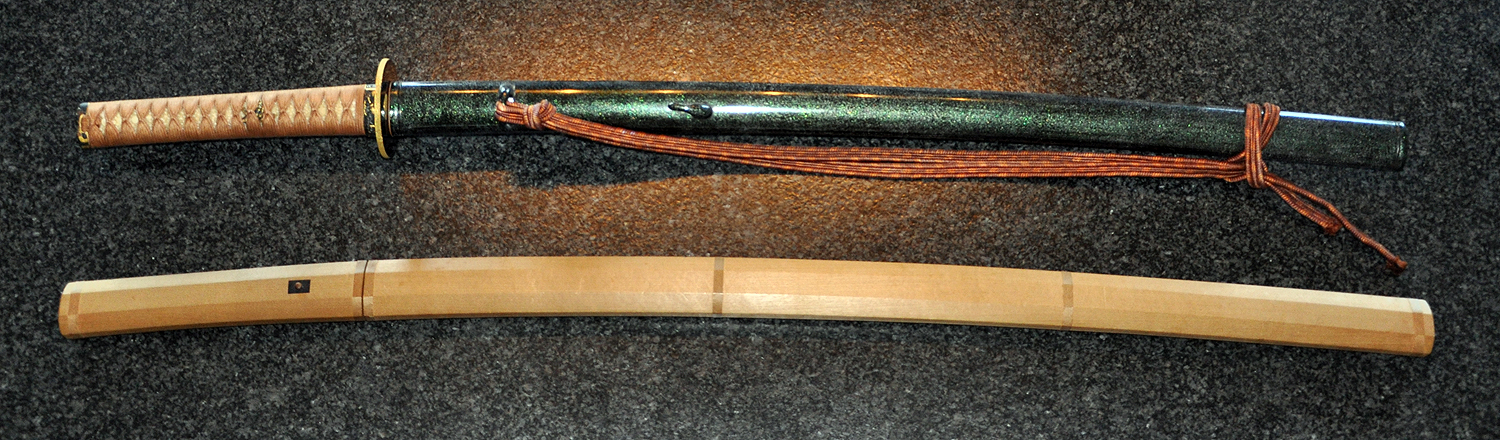
Object Type: Katana (Hitokuchi) in Koshirae
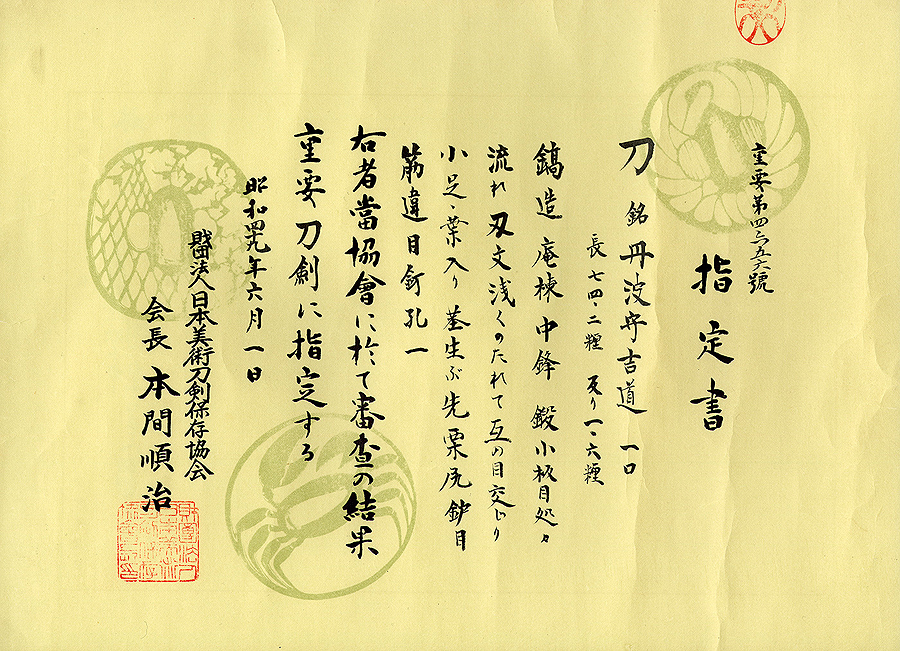
Blade Classification: Juyo Token (Officially Registered "Important Sword")
Blade Certificate Number: 4566
Swordsmith: Kyo-Shodai Tanba-no-kami Yoshimichi (1st Generation Kyoto)
School: Mishina School (Sanpin-ryu)
Era / Period: Early Edo Period / Keicho Era (ca. 1596–1615)
Signature: Oburi no goji-mei (Large, powerful 5-character signature)
Biography of the First Generation Kyoto (Kyo-Shodai)
Origin and Mino Roots
Yoshimichi was born in Seki, Mino Province. He was the third son of the famous master Mino-no-kuni Kanemichi (also read as Okane-michi). Kanemichi was a 9th-generation descendant of the legendary Soshu master Shizu Saburo Kaneuji, who was one of the most prominent students of the immortal Masamune.Yoshimichi grew up in one of the most talented blacksmith dynasties in Japan. His older brothers were Iga-no-kami Kinmichi and Izumi-no-kami Rai-Kinmichi, and his younger brother was Etchu-no-kami Masatoshi.
The Historic Move to Kyoto (1593)
At the end of the Muromachi period, in the year 1593 (Bunroku 2) – precisely the birth year of Toyotomi Hideyori –, the family accompanied the influential regent (Kampaku) Nijo Akizane upon his return to the imperial capital, Kyoto. They settled in the Nishinotoin district.Father Kanemichi and his four sons quickly became famous as the "Five Kyoto Smiths" (Kyo-Gonin-Kaji), establishing the absolute dominance of the Sanpin School (also called Mishina) in Yamashiro Province. In 1595 (Bunroku 4), Yoshimichi was officially granted the prestigious imperial honorary title "Tanba-no-kami".
Evolution of Signatures and Artistic Phases
The first generation Yoshimichi went through two major artistic phases in Kyoto, which are directly reflected in his signatures (Mei):
The "Fushimi Tanba" Phase (Early Keicho Era):
Yoshimichi worked temporarily in Fushimi for the court of Toyotomi Hideyoshi. His signatures from this period are angular and rigid. Swords from this era (often Wakizashi in flat construction) are robust, wide, and frequently feature simple, rustic straight temper lines (Suguha).
The "Hokake Tanba" Phase (Genna to Kan'ei Era):
In his mature phase, he drastically changed the calligraphy of the character "Tan". The wide, sweeping brushstroke strongly resembles the foresail of a traditional Japanese sailboat catching the wind (Hokake).
The Masterpiece and the Soshu Heritage
Yoshimichi went down in history as a genius innovator who invented the world-famous Sudareba (bamboo curtain) temper pattern. Before this pattern became rigidly controlled and geometric in later generations, Yoshimichi's early style was deeply influenced by the powerful Soshu-Masamune tradition.With immense effort, he forged monumental, magnificent swords rich in Ji-nie, golden lightning flashes (Kinsuji), and sand-like lines (Sunagashi). As a result, many of his unsigned works were historically misattributed directly to the legendary Soshu Masamune. Works by the first generation in full Katana length are exceptionally rare today.
Object Description of the Blade (Juyo Katana)
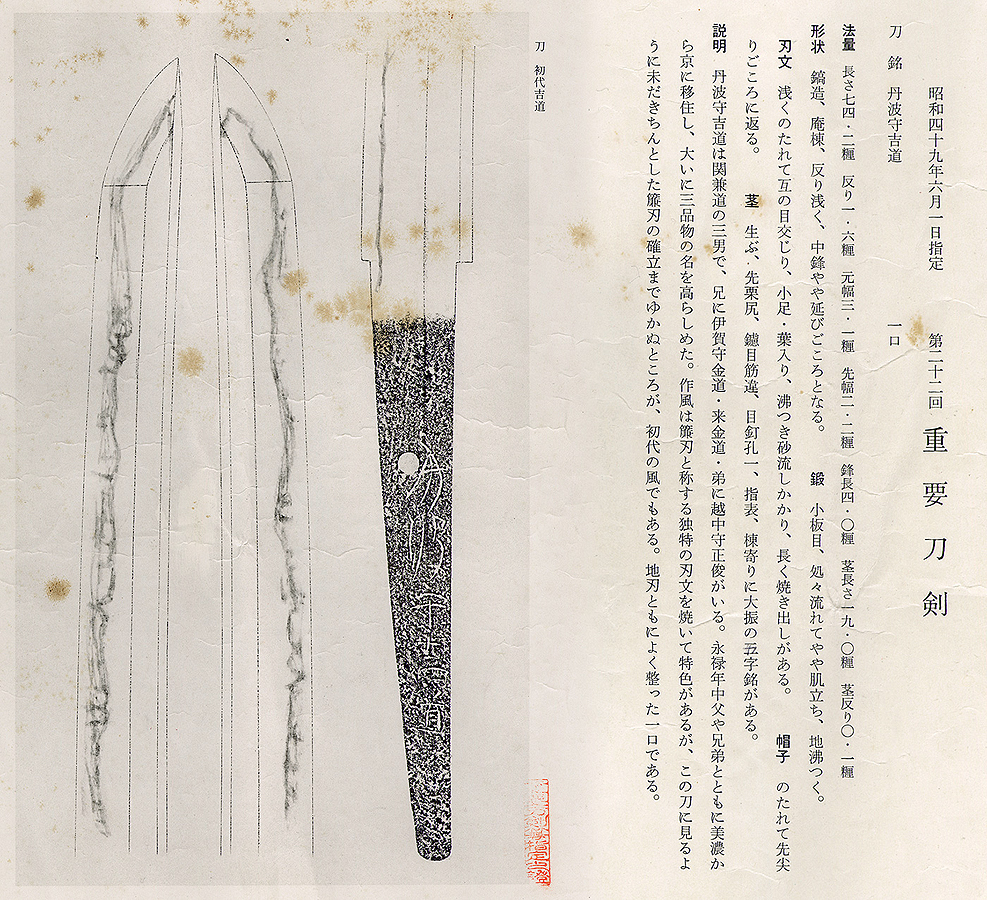
Designated on June 1, 1966, under NBTHK President Honma Junji. Officially cataloged in the 22nd Juyo Designation on June 1, 1974.
Technical Measurements and Proportions (Horyo)
Blade Shape (Sugata): Shinogi-zukuri (with ridge line), Iori-mune (ridgeback). The curvature is shallow and elegant. The medium tip appears proud and slightly elongated (Chu-kissaki yaya nobi-gokoro), perfectly embodying the powerful, defensive Keicho-Shinto style.
Blade Length (Nagasa): 74.2 cm
Curvature (Sori): 1.6 cm
Base Width (Moto-haba): 3.1 cm (exceptionally wide and powerful)
Tip Width (Saki-haba): 2.2 cm (retains excellent steel substance up to the tip)
Tip Length (Kissaki-nagasa): 4.0 cm (long, sweeping tip)
Tang Length (Nakago-nagasa): 19.0 cm
Tang Curvature (Nakago-sori): 0.1 cm (almost straight tang)
Inner Characteristics (Ji-ba)
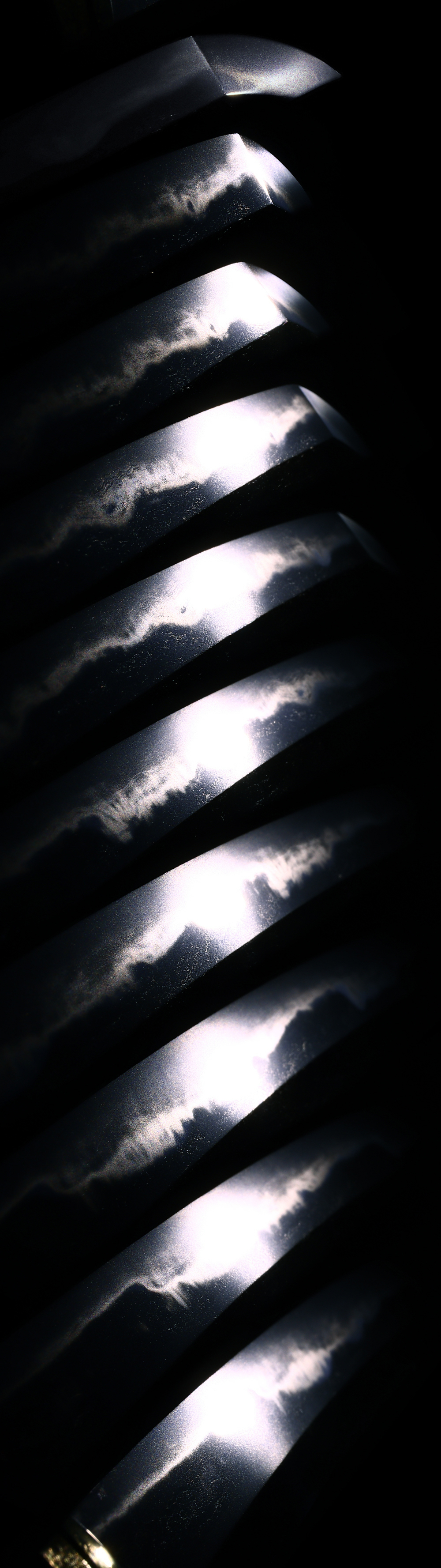
Steel Structure (Kitae / Jitetsu): A fine, dense wood grain (Ko-itame-hada) that flows and mixes in places (Nagare-hada), standing out slightly more prominently (hada-tachi). The entire surface is covered with a dense, glittering layer of finest crystalline structures (Ji-nie).
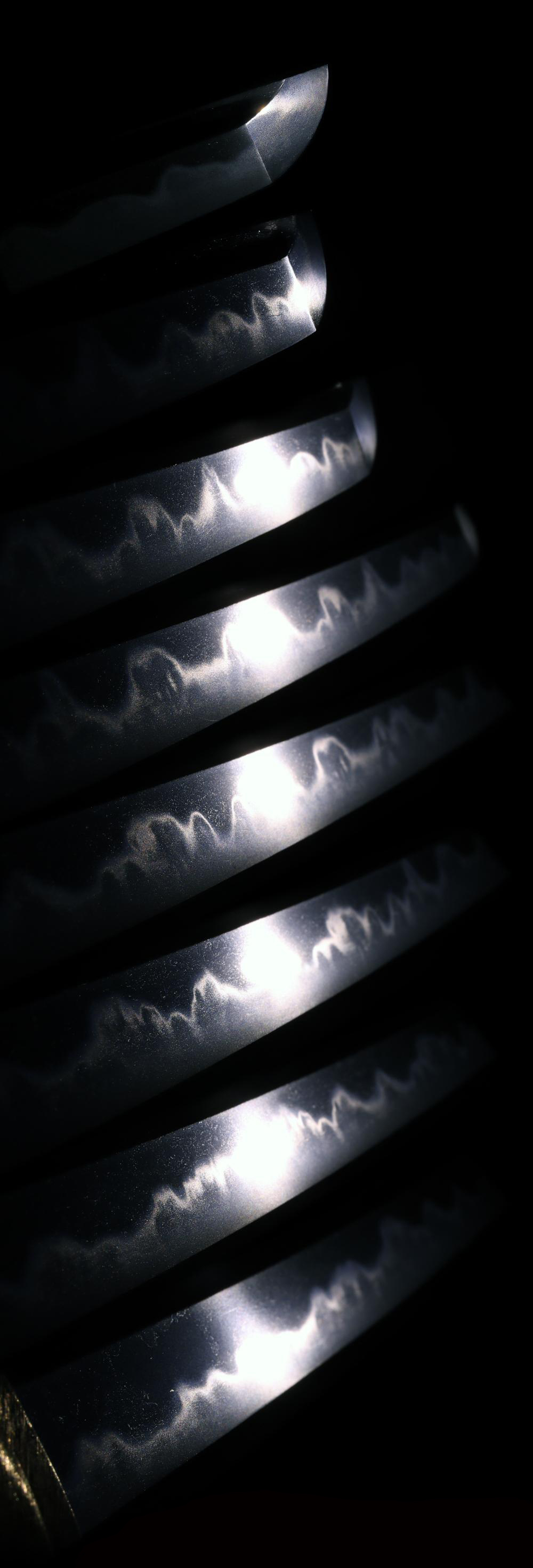
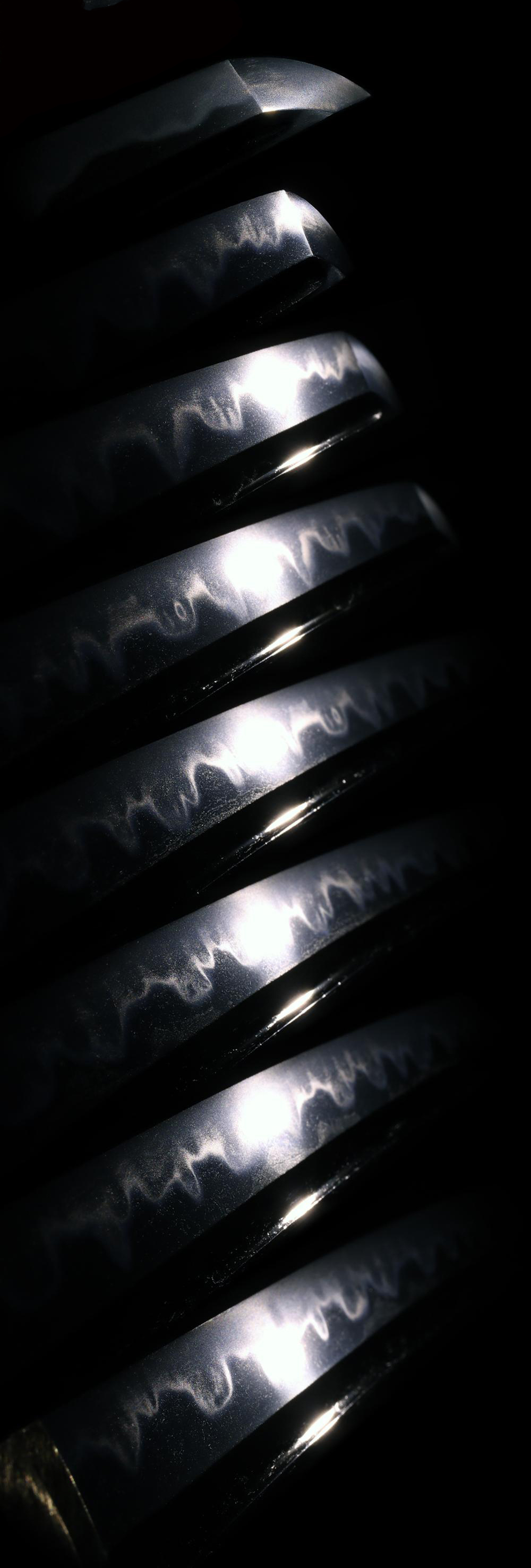
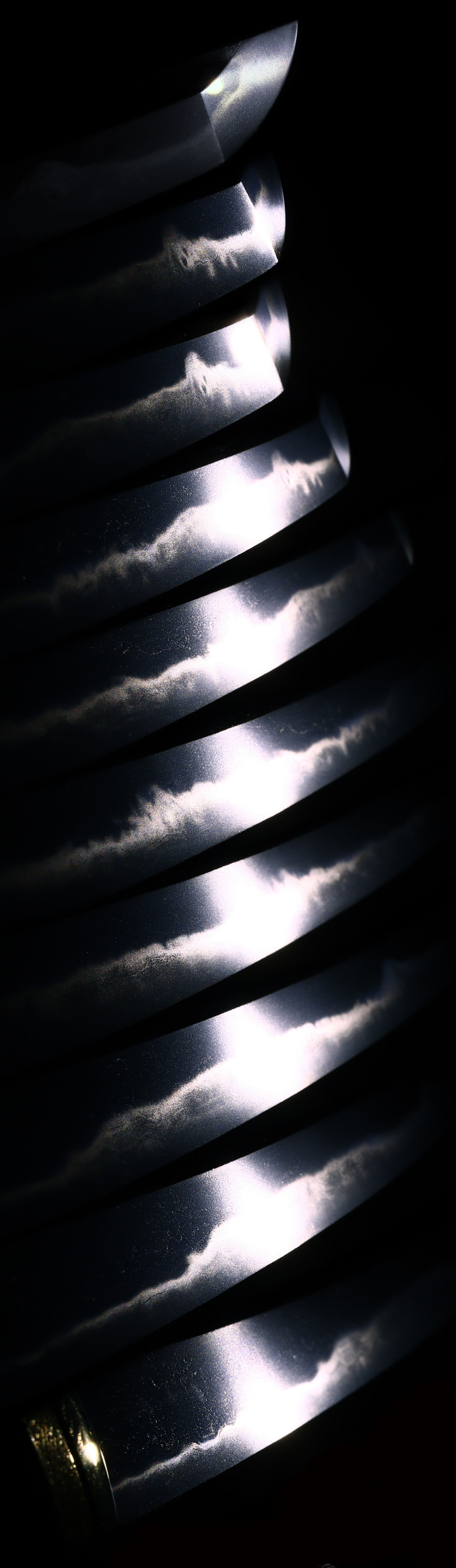
Temper Line (Hamon): The Hamon features a long, straight start at the base (Nagaku yaki-dashi ga aru). Above this, it transitions into a shallow wave pattern (Asaki-notare) mixed with round, undulating waves (Gunome).
Activities within the Hamon (Hataraki): The temper line is highly dynamic and active. It showcases fine vertical lines radiating into the cutting edge (Ko-ashi), isolated leaf-shaped temper points (Yo), dense crystal formations (Nie-tsuki), and pronounced sand-like streaks (Sunagashi).
Tip Tempering (Boshi): Follows a gentle wave pattern (notare), tapering slightly to a point near the tip (Saki togari-gokoro) before reversing elegantly (kaeru).
Condition of the Tang (Nakago)
The tang is in absolutely pristine, unaltered original condition (Ubu). The heel is rounded in a chestnut shape (Kurijiri), and the file marks run diagonally (Sujikai). There is only a single peg hole present (Mekugi-ana 1), proving the perfect state of preservation without any later alterations.
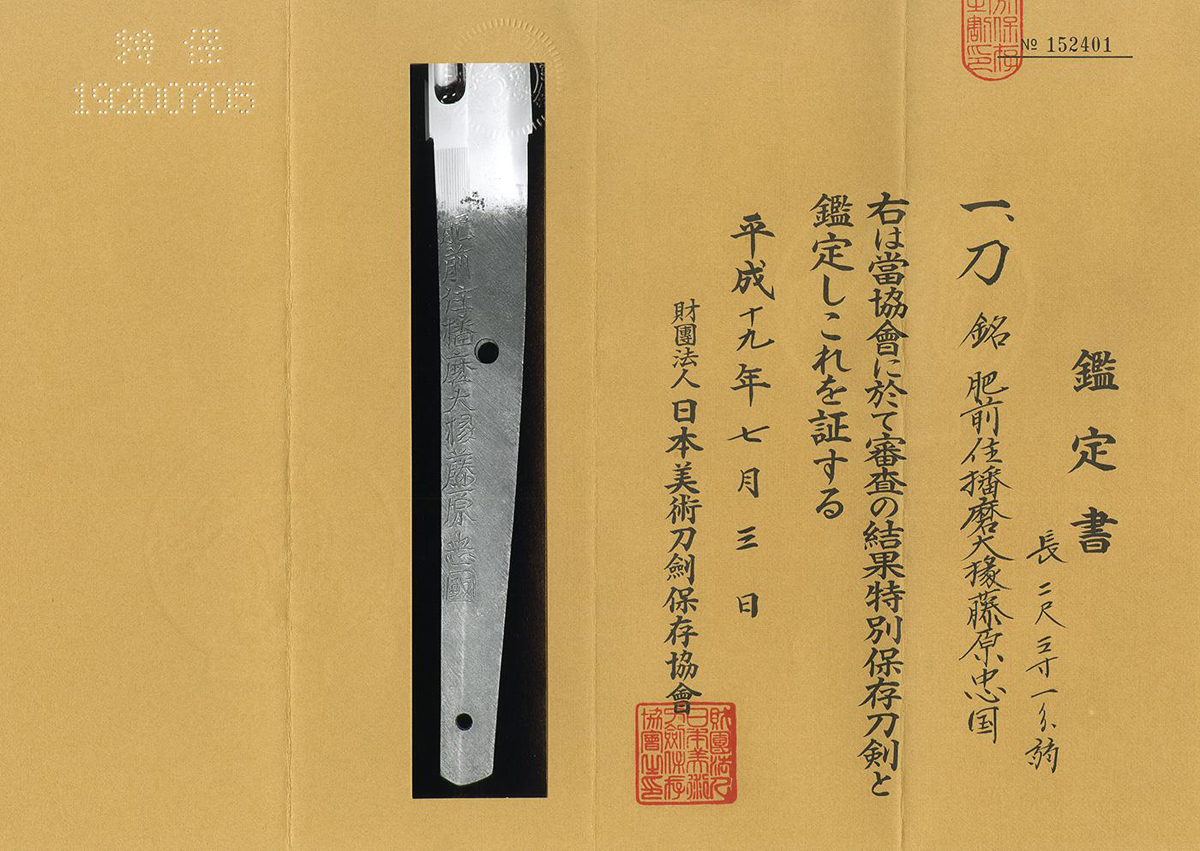
Inscription (Mei): On the outer side (Sashi-omote), near the back ridge, is the outstanding signature: Tanba no Kami Yoshimichi.
Description of the Koshirae (The Mounting)
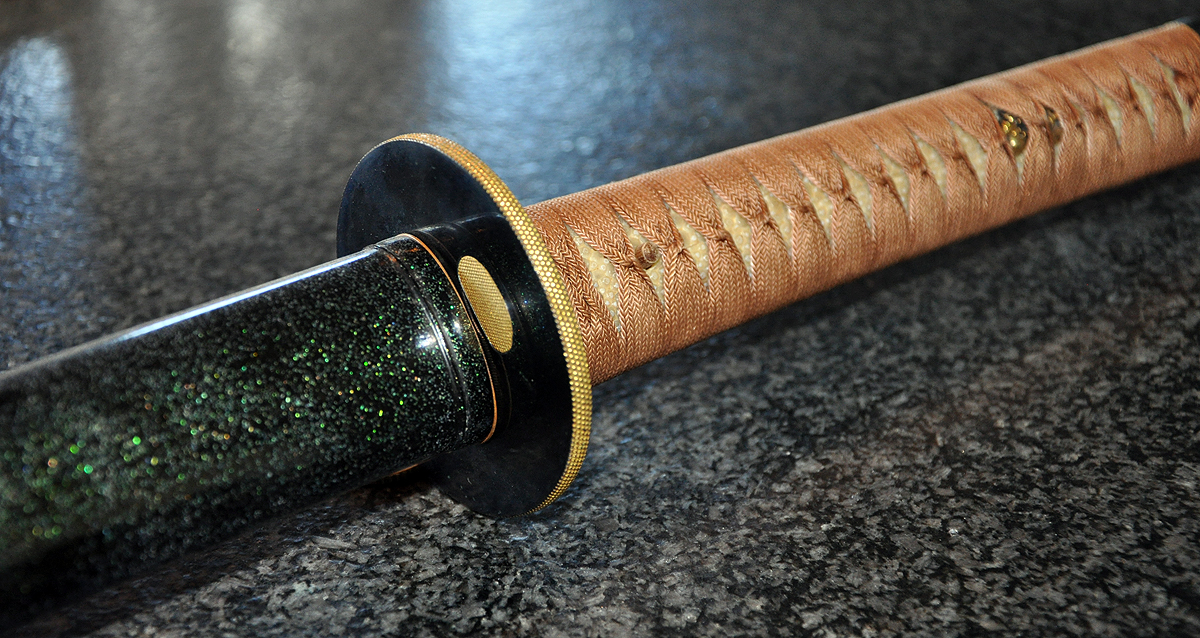
The sword is housed in an elegant, high-contrast master mounting that perfectly captures the aesthetic balance between martial readiness and traditional Shogunat-approved elegance.
Scabbard (Saya) and Cord (Sageo)
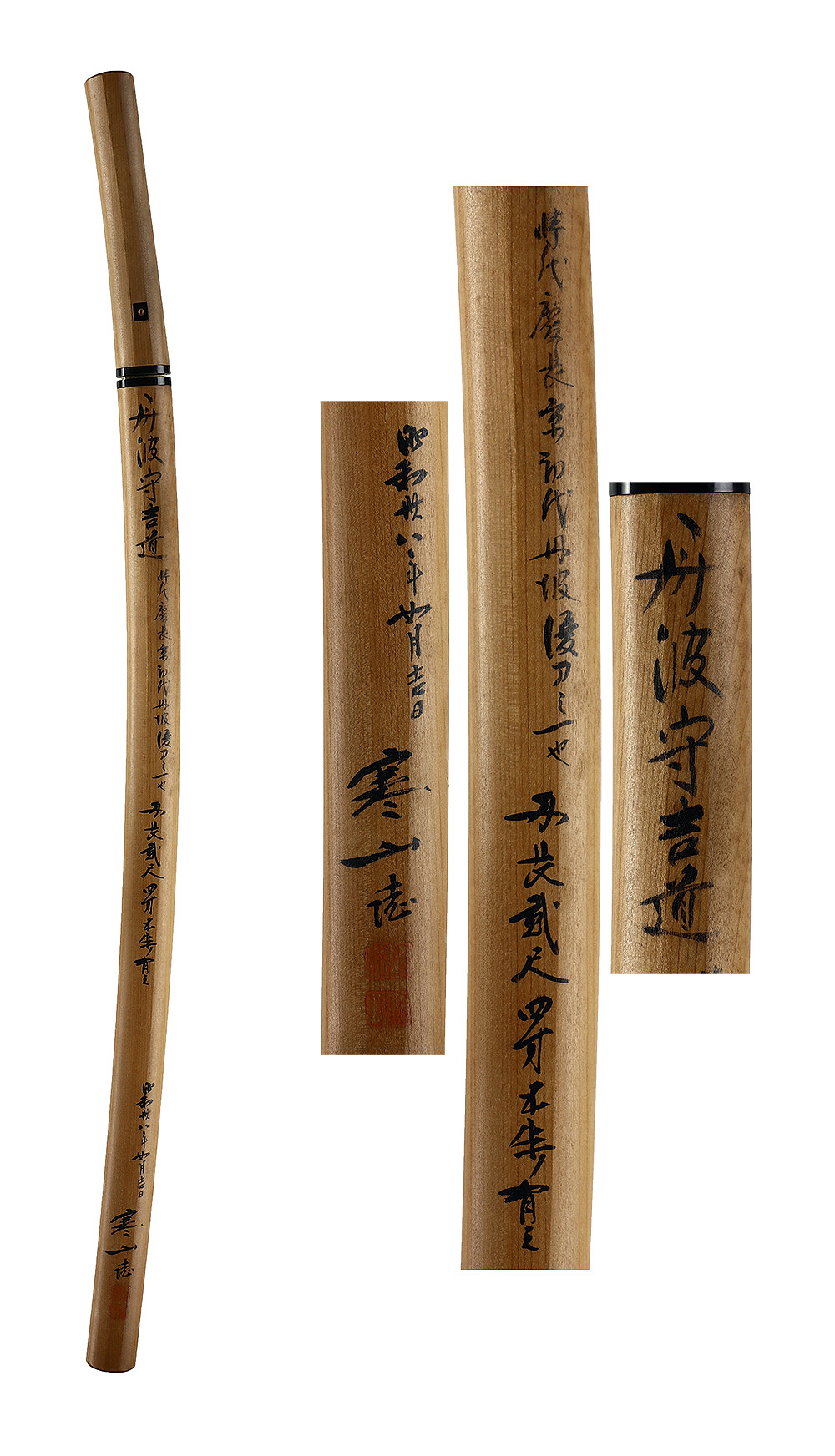
Saya: Finished in a deep, rich black lacquer (Kuro-urushi), providing a calm, classic contrast to the blade.
Sageo: A premium, radiant white silk cord (Silk Sageo), traditionally secured at the scabbard knob (Kurigata).
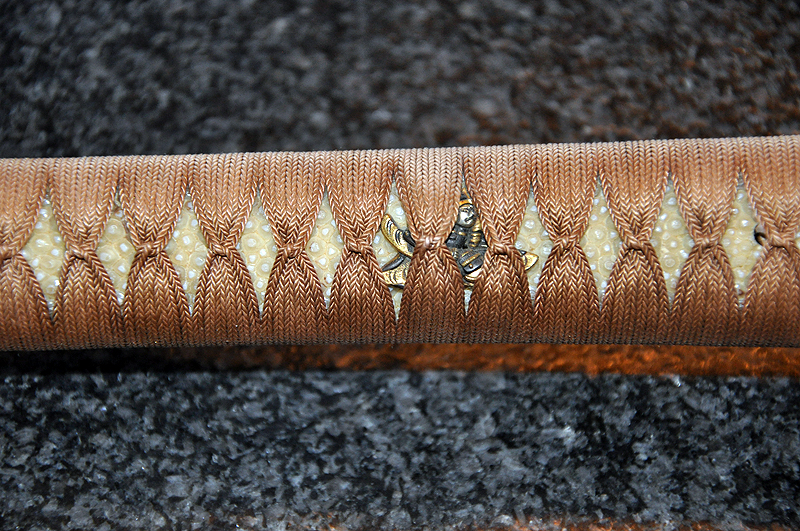
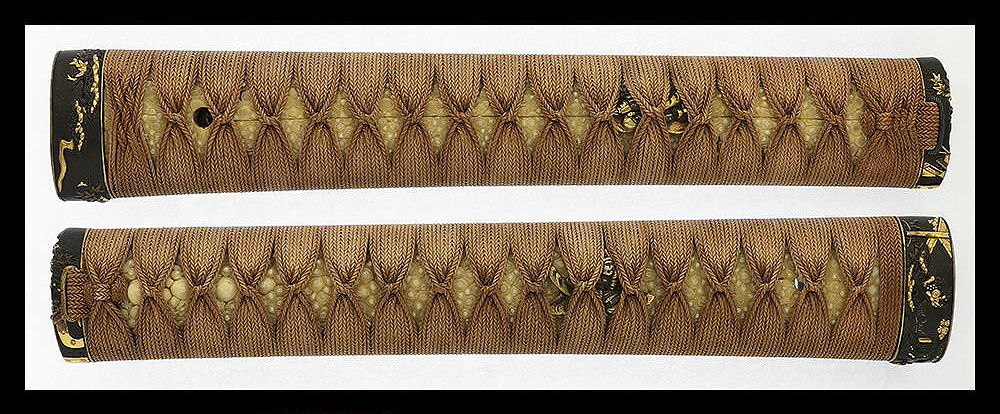
Hilt (Tsuka) and Hilt Fittings
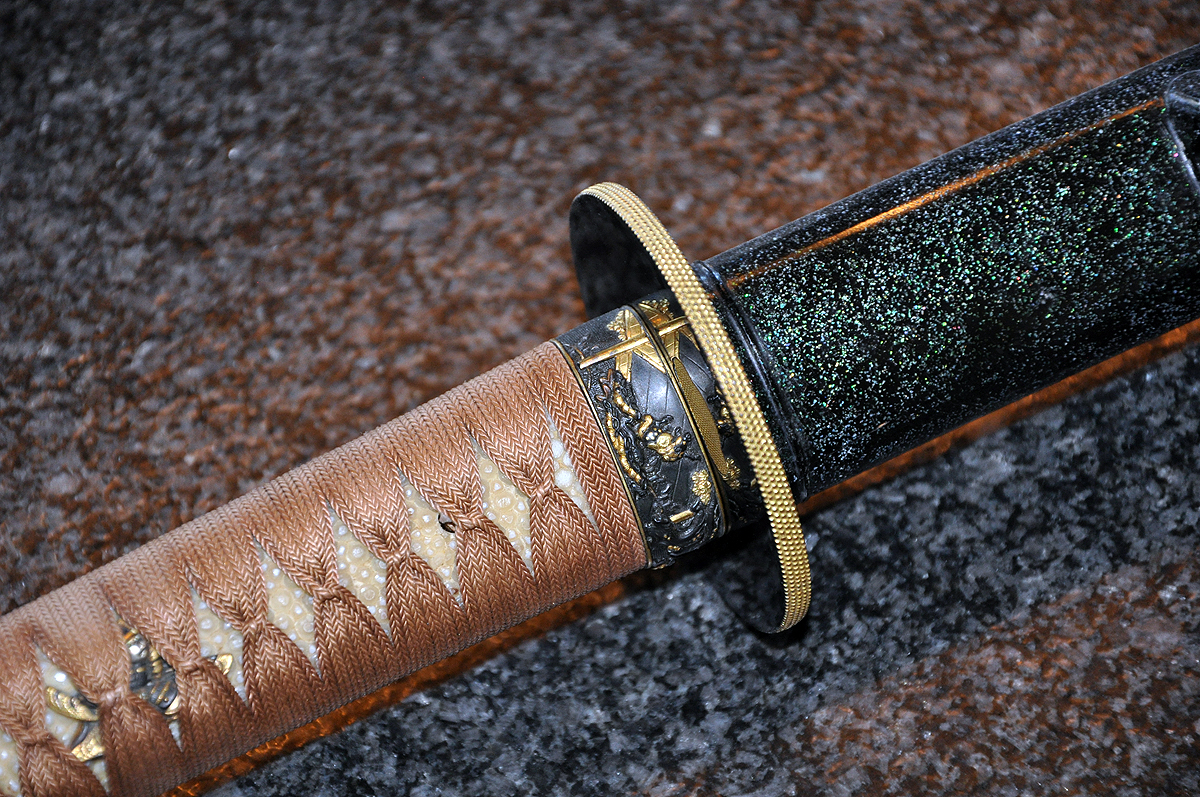
Rayskin (Samegawa): The wooden hilt is underlaid with immaculate, high-grade white rayskin.
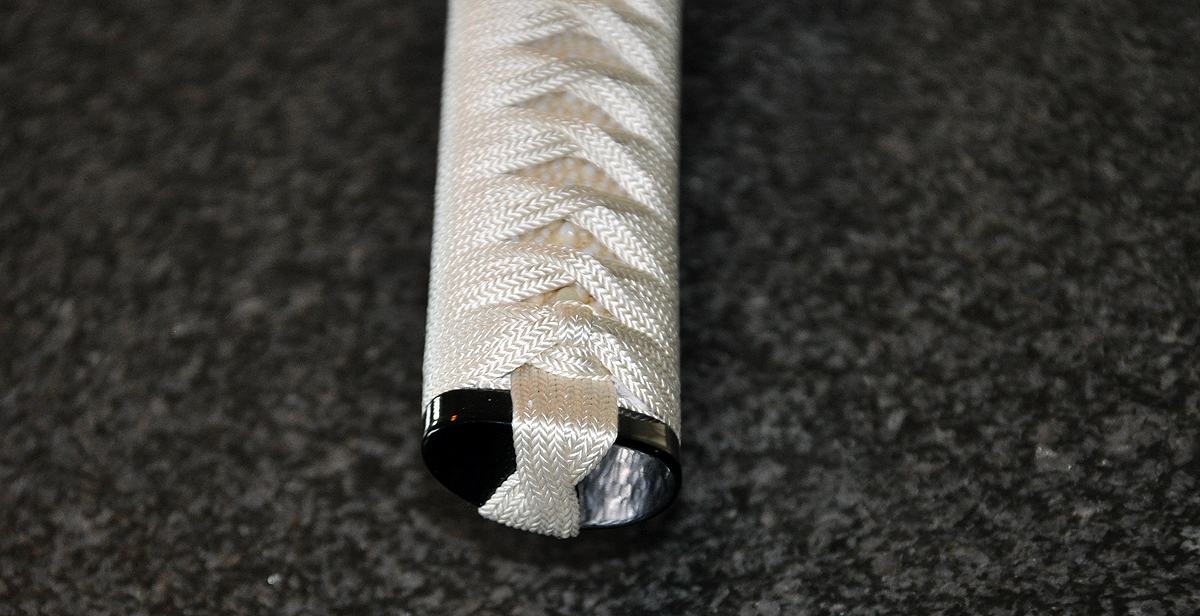
Wrapping (Tsuka-ito): An extremely complex, traditional Jabara-Ito cord wrapping in pure white. This braiding technique utilizes multiple fine cords interwoven to achieve an exceptionally secure grip.
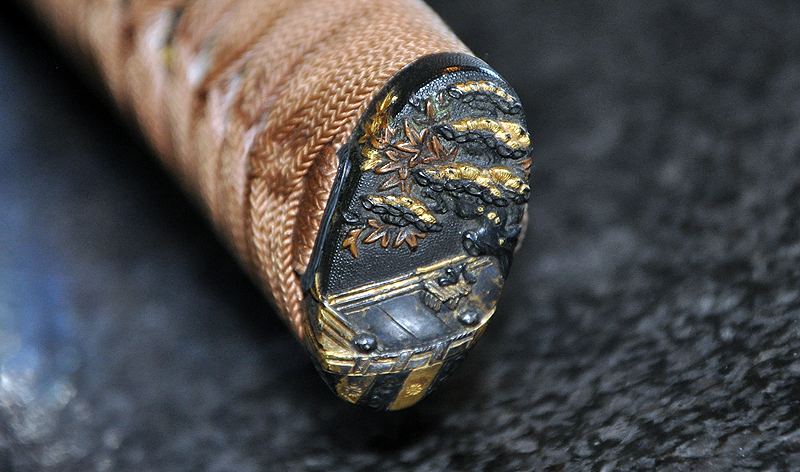
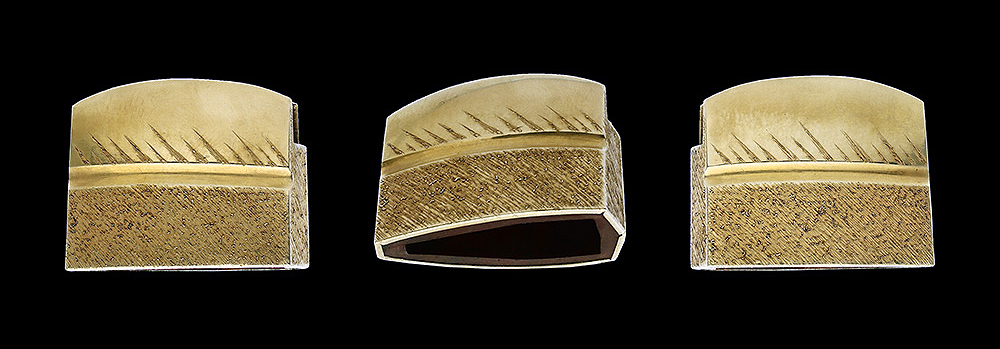
Pommel (Kashira): Crafted from fine, darkly polished genuine horn.
The Official NBTHK Hozon Certified Handguard: Tessen Hana Sukashi Tsuba (Choshu School)
The handguard (Tsuba) protects the user's hand and balances the blade. It is independently certified by the NBTHK:
Classification and Motif:
Tessen Hana Sukashi Tsuba – An iron handguard featuring delicate openwork piercing that depicts the elegant motif of the Clematis flower (Tessen, often referred to as iron clematis or vervain).
Attribution and School:
Choshu School (Nagato Province). The workmanship is attributed to this world-famous dynasty of masters, highly celebrated during the Edo period for their unrivaled, three-dimensional iron openwork in high relief.
Signature Status: Mumei (Unsigned). As is customary for many significant works from this sc
l, the piece is unsigned but has been definitively attributed to the Choshu School by the imperial experts.
Certification Level:
Hozon Tosogu – Officially registered as a "Value-rich and worthy of preservation sword fitting object".
The Masterpiece Hilt Collar (Fuchi) by Yoshioka Inaba no Suke
The Fuchi was crafted by the illustrious master dynasty Yoshioka Inaba no Suke, showcasing a harmonious natural design:
Floral Motifs:
On the right side, a highly detailed, fully opened blossom stands out in radiant gold (Kin-iro). Next to it is a semi-opened flower and a closed, upward-reaching bud (likely plum blossoms or chrysanthemums). The accompanying leaves and stems are sculpted in three-dimensional high relief, darkly patinated, and finished with precisely engraved leaf veins.
The Artisan Background Design (Nanako-ji):
The extremely fine, granular background of the dark metal (a precious Shakudo gold-copper alloy) consists of countless tiny, pearl-like droplets (fish-roe pattern). This structure was traditionally struck by hand, stroke by stroke, using a specialized punch. It breaks the light beautifully, maximizing the contrast of the golden reliefs.
About the Artist (Yoshioka School):
The Yoshioka family was a highly revered dynasty of sword fitting makers who worked exclusively for the Tokugawa Shogunate (Bakufu). Starting from the 2nd generation, the head of the house always inherited the honorary title "Inaba no Suke" across nine generations. Because they worked directly for the government, early works remained unsigned, while later generations from the 18th century onward signed with a full 5-character signature.
The Traditional Accessory: Simple Kogai (Hair Needle / Styling Tool)
Stored in a dedicated side pocket of the scabbard is a simple, single-piece Kogai. The decorated head section (Ji-ita) seamlessly mirrors the elite craftsmanship of the Koshirae:
Material and Base:
The base plate consists of a classic Japanese copper-gold alloy (Shakudo), chemically patinated to a deep blackish-blue hue. The surface features a fine, uniform fish-roe texture (Nanako-ji), identical to the Fuchi.
Decoration and Technique:
The exquisite relief showcases a traditional still-life motif. On the left side, a gnarled, blooming plum branch (Ume) stretches across the frame, accompanied by a traditional teapot/vessel and leaves. The elements are executed in crisp high relief (Takabori) and finished with contrasting rich gold inlay.
Symbolism:
In Bushido (the Samurai code), the finely sculpted plum branch represents endurance and strength, as the plum is the first flower to brave the winter snow and cold. This magnificent fitting (Tosogu) dates back to the peaceful Edo period, an era when functional samurai equipment evolved into premium status symbols of the highest artistic caliber.
Official NBTHK Expert Appraisal of the Blade (Setsumei)
"Tanba-no-kami Yoshimichi was the third son of Kanemichi His style is characterized by the tempering of a unique Hamon known as 'Sudareba' (bamboor curtain). The fact that the establishment of the exact, orderly Sudareba is not yet fully completed on this sword is the typical characteristic of the very first generation (Shodai). As an early work, it masterfully demonstrates the transition from the wild, crystal-rich Soshu tradition toward the development of his own proprietary style. Both the steel and the temper line are excellently matched. It is an outstanding piece."
Metallurgical Analysis:
The Phenomenon of Yaki-dashiThis sword provides an excellent case study for a fascinating physical phenomenon of the early Shinto era: the Yaki-dashi. The presence of this distinct, unusually long and straight tempered section right above the base (Hamachi) is no coincidence. It is the result of a deliberate, masterfully controlled management of thermodynamics and crystallization by the first-generation Yoshimichi from Kyoto.
From a metallurgical perspective, this physical process unfolds as follows:
Targeted Control of Thermal Conductivity (Clay Application)
To shape the blade's later activity, the smith controlled the cooling speed via the thickness of the specialized clay mixture (Yakiba-tsuchi). While he applied the clay in a razor-thin, wavy fashion along the upper portion of the blade to achieve the tempestuous Soshu look, he deliberately applied a straight, thick horizontal barrier of clay at the base.
The Thermodynamic Process During Quenching (Yaki-ire)
Upon plunging the heated steel (approx. 800 degrees Celsius) into cold water, two entirely different physical transformations occurred within a highly confined space:
In the upper blade section:
The steel cooled instantly. The carbon atoms were trapped and frozen within the crystal lattice. This resulted in the formation of the extremely hard, light-refracting martensite structure (Nie/Nioi).
At the base (Yaki-dashi): The thick, straight layer of clay acted as a thermal insulator. It kept the water away from the steel for crucial milliseconds. The cooling process was delayed here, forming a much softer, highly elastic mixed microstructure of pearlite and troostite instead of brittle martensite.
Functional and Structural Logic of the Blade
This long Yaki-dashi showcases the true genius of Kyo-Shodai Yoshimichi. With it, he successfully resolved two fundamental structural issues of blade statics:
Fracture Prevention:
He created a highly flexible transition zone at the most physically stressed junction of the blade – where the tang meets the cutting edge (Machi). This effectively prevented blade fractures during heavy impacts.
Structural Balance:
He stabilized the foundation of the weapon. This structural baseline made the wild, razor-sharp hardness of the upper Soshu structure practically viable and highly maneuverable in combat.
Kyo-Shodai Tanba-no-kami Yoshimichi - #S0107
Sigature: Kyo Tanba no kami Yoshimichi (First Generation)
Nagasa: 74.10 cm
Sori: 1.52 cm
Motohaba: 3.19 cm
Motokasane: 0.75 cm
Hamon: Notare - Gunome with Sunagashi, Yo and Nie
Jihada: Itame with Nie
Paper: NBTHK Juyo Token / NBTHK Hozon for Tsuba
Koshira: Shirasaya +Katana Koshira
Price: EUR